Curating Your Life Isn't Selling Out — It's Editing With Intention
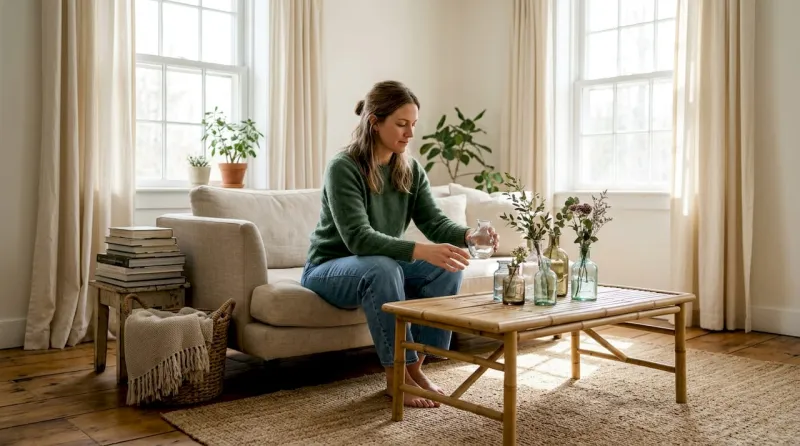
Photo: woman arranging stylish home decor thoughtfully with natural light, via cozee-bay.com
Somewhere along the way, "authentic" became a synonym for "unfiltered." Post the messy kitchen. Show the bad skin day. Share the ugly cry. And look — there's genuine value in that kind of honesty. But somewhere in our collective sprint away from performative perfection, we overcorrected. Now, if you put effort into how you present yourself — your home, your wardrobe, your Instagram grid — there's this low hum of suspicion that follows you around. Are you being real, or are you just building a brand?
Here's what I actually think: that's a false choice. And the pressure to choose between them is making a lot of people feel guilty for simply caring about how they show up in the world.
What Curation Actually Means
Let's start by separating two things that often get tangled together: performance and presentation.
Performance is when you construct an image specifically to manage how others perceive you — to seem more successful, more enviable, more put-together than you actually feel. It's exhausting, it's hollow, and yes, it does erode your sense of self over time.
Presentation is something else entirely. It's the act of choosing what to emphasize, what to step back from, and how to show up in a way that feels aligned with who you are — or who you're becoming. A good editor doesn't include every scene in a film. That doesn't make the film dishonest. It makes it intentional.
When you spend time putting together an outfit that makes you feel like yourself, you're not being fake — you're being deliberate. When you style your living room in a way that makes you genuinely happy to come home to, you're not performing domesticity for an imaginary audience. You're creating a space that reflects your actual values and tastes.
Curation, at its best, is just editing. And editing is a skill.
The Social Media Guilt Trip
Of course, a lot of this anxiety lives online. We're all acutely aware that what we post is, by definition, selected. You chose that photo. You wrote that caption. You hit publish on that version of your Saturday afternoon and not the one where you were anxious and ate cereal for dinner.
And somehow that awareness — that the feed is a highlight reel — has made people feel like they owe the internet their worst moments as proof of their humanity.
But here's the thing: you don't. You genuinely do not.
Sharing the parts of your life that feel meaningful, beautiful, or worth celebrating isn't deception. It's discretion. The same way you don't walk into a job interview and lead with your insecurities, you don't have to lead with your chaos online just to prove you have some. Everyone has some. That's not the interesting part.
What becomes problematic is when the gap between your curated self and your actual self gets so wide that you lose track of which one you believe. When you're performing a version of wellness you don't practice, or projecting a confidence that's entirely disconnected from how you feel inside — that's when curation tips into something that genuinely costs you.
A Simple Framework for Checking In With Yourself
If you're not sure which side of the line you're on, here are a few questions worth sitting with:
Does it feel like expression or like effort to maintain? Genuine curation tends to feel energizing. You're sharing something because it resonates, not because it fits a narrative you're trying to protect. If keeping up a certain image feels like a second job, that's worth paying attention to.
Are you editing, or are you hiding? There's a difference between not sharing everything and actively constructing a false impression. Leaving things out is human. Actively misleading people — about your finances, your relationships, your health — is a different thing entirely.
Would you feel embarrassed if people saw behind the curtain? A little, sure — that's normal. But if the answer is a deep, anxious yes, it might be worth asking what you're protecting and whether it's serving you.
Does your curated self feel like an aspirational version of you, or a completely different person? The former is healthy. You're allowed to present the version of yourself you're working toward. The latter is worth examining.
The Style Angle Nobody Talks About
I want to bring this back to something concrete, because I think style is actually one of the clearest places to see this dynamic play out.
Getting dressed with care — building a wardrobe that reflects your taste, that makes you feel capable and put-together — is one of the most tangible forms of self-curation there is. And it is absolutely an act of self-respect, not vanity.
When someone tells you they "don't care about clothes," they're often actually saying they haven't yet found a visual language that feels like theirs. Because once you do? Once you figure out the silhouettes and colors and textures that make you feel like you? It's not shallow. It's grounding.
The same is true for your home, your social media presence, your dinner party menu. These things are expressions of your taste and your values. The fact that other people can see them doesn't make them fake. It just means you're a person who exists in the world.
Authenticity Isn't About Showing Everything
Real authenticity — the kind that actually builds trust and connection — isn't about radical transparency. It's about alignment. It's the sense that what you're putting out into the world is genuinely connected to what's going on inside.
You can be deeply authentic and still keep things private. You can be intentional about your appearance and still be honest. You can post the beautiful Sunday brunch photo without owing anyone a picture of Monday's anxiety spiral.
The goal isn't to perform rawness any more than it's to perform perfection. It's to live a life that feels true to you — and then share the parts of it you actually want to share, in the way you actually want to share them.
That's not a paradox. That's just living thoughtfully.
And in a world that constantly pressures you toward both extremes — total exposure or polished performance — choosing the middle ground, with intention, might be the most authentic thing you can do.